Hardware Fingerprinting
Mobile devices are defined by their constraints. Testing a website on a high-end desktop CPU rarely reveals the performance bottlenecks that occur on real-world mobile hardware. Emuluxe’s Hardware Fingerprinting engine mocks low-level browser APIs to simulate the physical performance characteristics of your target device.
The Performance Simulation Layer
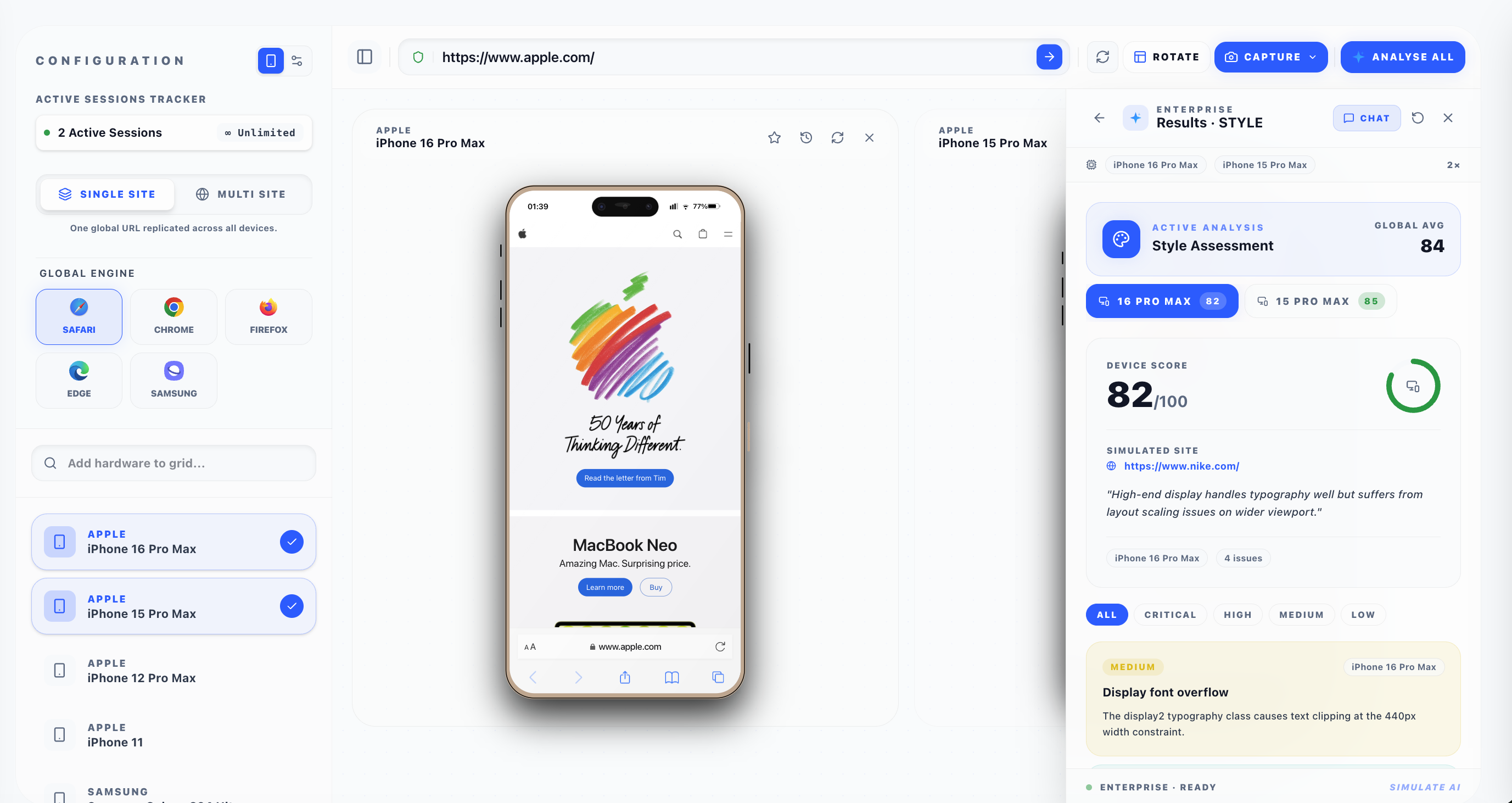
Every profile in the Foundry includes a Hardware Fingerprint that is injected into the simulated browser session:
1. Concurrency & Memory
Emuluxe mocks the navigator object to report hardware-correct values:
navigator.hardwareConcurrency: Reflects the actual number of logical processor cores available to the device (e.g., 6 for iPhone 16, 8 for Pixel 9).navigator.deviceMemory: Limits the reported RAM (e.g., 2GB, 4GB, or 8GB), ensuring that memory-hungry JavaScript applications correctly optimize for low-spec devices.
2. GPU & WebGL Simulation
We intercept WebGL and WebGPU contexts to report hardware-accurate renderer strings:
- Vendor & Renderer: Mocks strings like "Apple GPU" or "Adreno 750," ensuring that specialized shaders or performance-tiering logic in your app detects the appropriate hardware level.
- Canvas Throttling: Limits the framerate and texture memory to mimic the thermal and energy-saving constraints of mobile chipsets.
Thermal Throttling
A unique Foundry feature, Thermal Throttling, simulates the behavior of a device that is under heat-stress:
- Clock-Speed Jitter: Introduces subtle fluctuations in JavaScript execution speed.
- Main-Thread Prioritization: Simulates the stricter backgrounding policies of mobile OSs, where inactive tabs or background workers are throttled more aggressively.
Why testing Hardware matters
Testing on a desktop hides major mobile-first issues:
- Main-Thread Bottlenecks: Heavy JS bundles that run smoothly on desktop can cause "Jank" or input delay on mid-range Android CPUs.
- Memory Leak Crashes: Sites that use excessive memory can be killed by the OS on legacy devices (like the iPhone 11).
- Adaptive Graphics: Verifying that high-fidelity maps or 3D models correctly degrade for lower-tier hardware.
[!IMPORTANT] Hardware Fingerprinting is a Pro tier feature, essential for performance-critical applications and high-fidelity audits.
Next, see how we handle Safe Area & Layout.